Quick answer: how to store Sichuan ingredients depends on the ingredient, whether the package is opened, and what its label says. Keep dry chilies, Sichuan peppercorns, dried mushrooms, and fermented black beans sealed away from heat, light, and moisture. Keep products that say “refrigerate after opening” in a refrigerator at 40°F (4°C) or below. Do not apply one homemade shelf-life chart to every doubanjiang, chili oil, sesame paste, vinegar, or pickle; formulas and processing differ.
A good storage system protects two different things. Food-safety controls address temperature, package damage, contamination, and spoilage. Quality controls protect fragrance, color, texture, and flavor. A peppercorn can become flat and dusty without becoming dangerous, while an opened product that required refrigeration can create a safety problem even if its aroma still seems acceptable.
This guide gives you a repeatable decision process for a home kitchen. If you are still building your pantry, start with our guide to essential Sichuan ingredients, then return here to organize each package after purchase.
Start with the package, not a universal chart
Before moving an ingredient into a matching jar, photograph or keep the original label. Record the product name, lot information, best-by date, ingredients, and storage directions. “Shelf stable,” “refrigerate after opening,” and “keep frozen” are not interchangeable instructions. The manufacturer’s directions reflect that product’s formulation and packaging; a similar-looking jar from another brand may use a different process.
| Ingredient type | First storage decision | Main risk to control | Practical check |
|---|---|---|---|
| Whole dried chilies and peppercorns | Cool, dry, dark pantry in a tight container | Moisture, insects, heat, and aroma loss | Look for condensation, clumping, webbing, or musty odor |
| Dried mushrooms and dried tofu skin | Use the unopened package directions; reseal tightly after opening | Moisture reabsorption and pests | Keep pieces dry and inspect the container before use |
| Doubanjiang, sesame paste, chili sauce, and pickles | Follow the specific after-opening label | Wrong temperature, dirty utensils, or damaged seal | Use a clean dry spoon and close promptly |
| Vinegar, soy sauce, and cooking wine | Follow the bottle label; protect from heat and direct sun | Flavor deterioration and contamination at the cap | Wipe the rim and keep the closure clean |
| Homemade oils, sauces, or pickles | Use a tested recipe with its stated storage method | Unverified process and unsafe time-temperature handling | Do not substitute a commercial product’s date for a homemade batch |
Step by step: build three storage zones for Sichuan ingredients
Zone 1 is a cool, dark pantry. Choose a cupboard away from the stove, dishwasher, sink, and sunny window. The FDA’s pantry guidance warns against storing shelf-stable packages above the stove, under the sink, or anywhere temperatures fluctuate. Put frequently used whole spices near the front, but keep them behind a closed door rather than in direct light.
Zone 2 is the refrigerator. Use it for products whose labels require refrigeration after opening and for other perishable items. The FDA advises keeping the refrigerator at 40°F (4°C) or below, leaving space for cold air to circulate, and keeping foods covered. A small appliance thermometer is more useful than guessing from how cold a jar feels.
Zone 3 is optional freezer space. Freezing can be a quality-management choice for some dry ingredients bought in bulk, but it is not a universal rule. Divide the ingredient into small, moisture-resistant portions, allow a sealed portion to return toward room temperature before opening, and avoid repeated warm-cold cycles that can encourage condensation. If the package gives different directions, the package wins.
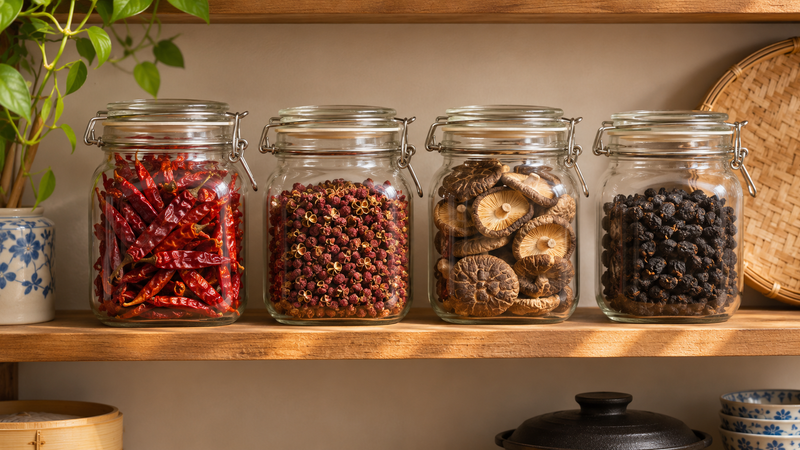
Store dry spices to control moisture, heat, and light
The National Center for Home Food Preservation recommends packaging dried foods in clean, dry containers with tight-fitting lids and keeping them in cool, dry, dark conditions. It also notes that reopening exposes food to air and moisture. That makes smaller working jars useful: keep a modest amount near your cooking area and leave the reserve sealed in the better storage location.
- Keep whole spices whole until needed. Whole Sichuan peppercorns and whole dried chilies generally expose less surface area than ground spice. Grind or crush a small amount for the dish rather than turning the entire purchase into powder.
- Use a completely dry container. A washed jar must be dry before filling. Do not pour new spices on top of old crumbs; empty, clean, and dry the container first.
- Use a dry utensil. Steam from a wok or wet spoon can introduce moisture. Spoon out what you need away from the cooking steam, then close the container.
- Buy at your actual cooking pace. A large bargain bag is poor value if the aroma fades before you use it. Portion size should match how often you cook.
- Inspect, do not merely sniff. Look for condensation, clumping, visible mold, insects, webbing, or a package that no longer seals. A weak aroma alone signals quality loss, but moisture or pests require a different decision.
Do not use heat to “dry-can” packaged spices in jars. Heat can trap residual moisture and does not turn an improvised method into a tested preservation process. For normal home use, clean dry containers and controlled storage conditions are the clearer approach.
Handle opened pastes, sauces, and oils by label
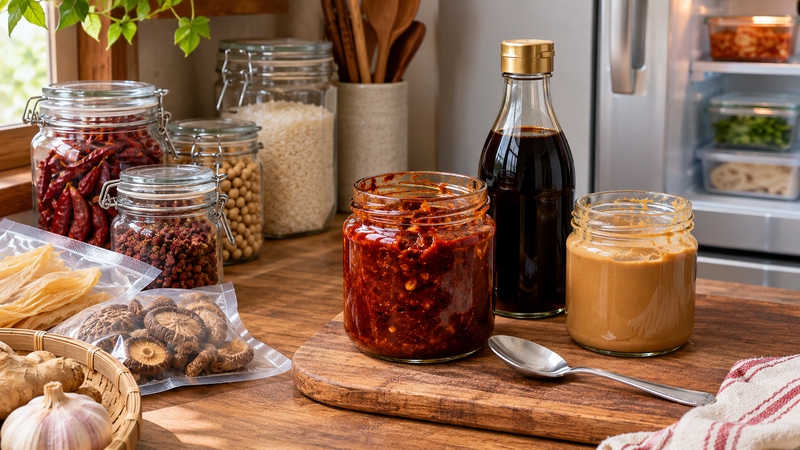
Doubanjiang is a useful example because products can differ in salt level, fermentation, additives, packaging, and after-opening directions. Our separate doubanjiang facts guide explains its culinary role; the package in your hand determines its storage rule. If the label says to refrigerate after opening, refrigerate it promptly and keep the lid and rim clean.
Use a clean dry spoon instead of dipping a tasting spoon back into a paste. Remove spills from the rim before closing. Do not leave an opened jar beside a hot stove throughout dinner and then treat refrigeration as a reset button. Cold storage slows many changes, but it does not reverse contamination or time spent outside the required conditions.
Oil-based products deserve careful wording. Commercial chili oil or mala sauce follows its own label. Homemade garlic-in-oil or other infused mixtures should follow a tested recipe and its storage instructions; do not borrow the date from a commercial bottle. If you make our Sichuan mala sauce recipe, keep its batch size, process, and storage notes together rather than relying on memory.
Use a five-minute monthly storage check
A storage system works only if you can maintain it. Once a month, check the small number of things that change the decision.
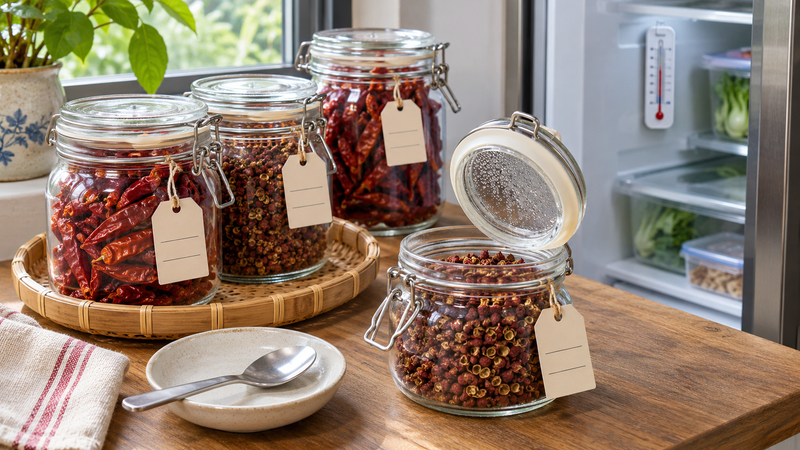
- Read the refrigerator thermometer. Confirm 40°F (4°C) or below rather than trusting the control dial.
- Check closures. Tighten lids, wipe sticky bottle necks, and replace cracked containers.
- Look for moisture. Condensation inside a dry-food jar, softening pieces, or new clumps mean the storage condition changed.
- Check labels and dates. Keep the original instructions with transferred foods. Mark the opening date as a reminder, not as a substitute for a safety rule.
- Reduce duplicates. Combine only identical products from the same batch when their condition is sound. Do not pour a new purchase onto an unknown old remainder.
- Move slow-use reserves. If heat reaches the working shelf, relocate reserve packages to a cooler cupboard and keep only a small amount near the stove.
The USDA-supported FoodKeeper resource can help you look up broad categories such as condiments, sauces, canned goods, and shelf-stable foods. Use it to supplement—not erase—the product label. When a specific package gives a more restrictive direction, follow that direction.
When to discard an ingredient
Discard a product when its package is leaking, swollen, badly damaged, or no longer able to close as intended; when visible mold or pests are present; when a refrigerated item was held outside its required temperature and you cannot establish that it remained safe; or when its label gives a discard instruction that applies. Do not taste a questionable food to test it.
Quality loss is more nuanced. Faded color, weaker fragrance, or a stale taste may make a dry spice disappointing before it becomes a safety problem. Replace it when it no longer contributes the flavor the recipe needs. Keep that judgment separate from mold, moisture, package failure, or temperature abuse.
Questions about storing Sichuan ingredients
Should Sichuan peppercorns be refrigerated?
Not automatically. For routine use, keep whole peppercorns tightly sealed in a cool, dry, dark place. Refrigeration can expose the container to condensation when it is repeatedly opened. If you freeze a bulk reserve for quality, divide it into sealed portions and avoid opening a cold package in humid air.
Does doubanjiang need refrigeration after opening?
Follow the exact product label. Formulas and packaging vary, so one answer cannot safely cover every jar. When refrigeration is required, keep the refrigerator at 40°F (4°C) or below and use a clean dry spoon.
Can dried chilies go in the freezer?
They can be portioned and frozen as a quality-management option, especially for a large reserve, but the package must protect against moisture. Let a sealed portion temper before opening so humid air does not condense on the chilies. A cool dry pantry remains simpler for quantities you will use regularly.
How can I tell if a dried Sichuan ingredient absorbed moisture?
Look for condensation, unusual clumping, softening, a musty odor, or visible mold. The NCHFP advises checking dried foods to confirm they remain dry. Moldy food should be discarded rather than dried again and served.
Sources and safety boundaries
- National Center for Home Food Preservation: Packaging and Storing Dried Foods — moisture, container, insect, heat, and light controls for dried foods.
- FDA: Refrigerator Thermometers—Cold Facts about Food Safety — refrigerator temperature, circulation, covered storage, and discard cautions.
- FoodSafety.gov: FoodKeeper — category-specific storage lookup for condiments, sauces, shelf-stable foods, and other products.
- FDA: Play It Safe with Ready-to-Eat Foods — cool, dry pantry placement and package-damage checks.
Boundary: this article explains general home-storage decisions. It does not override a product label, recall notice, local public-health instruction, or tested preservation recipe, and it does not assign a universal after-opening life to all Sichuan condiments.