This Sichuan dumpling version follows Zhong-style small pork dumplings served with sweetened soy sauce and red chili oil. The filling is pork with a strained ginger, scallion and peppercorn infusion, not a cabbage-heavy filling or an unrelated bowl of noodles. Small half-moon parcels leave enough wrapper surface for the dressing.
Quick Answer
Prepare the aromatic water, cool and strain it, then mix a sticky seasoned pork filling. Put a modest amount in each wrapper, seal securely and boil in manageable batches until the filling is safely cooked. Drain and coat small portions with a separately measured sweet-soy and chili-oil dressing.
Basic Facts
| Filling batch | 400 g pork with about 20% fat |
|---|---|
| Wrapper | Store-bought round dumpling wrappers; count depends on wrapper size and filling used |
| Shape | Small half-moon parcels, around 1/2 tablespoon filling each |
| Cooking check | Ground pork reaches 71°C (160°F), not merely floating wrappers |
| Per-serving dressing | 1 tablespoon Sichuan sweetened soy sauce, 1 teaspoon red chili oil and 1 teaspoon minced garlic |
Prepare filling, wrappers and sauce
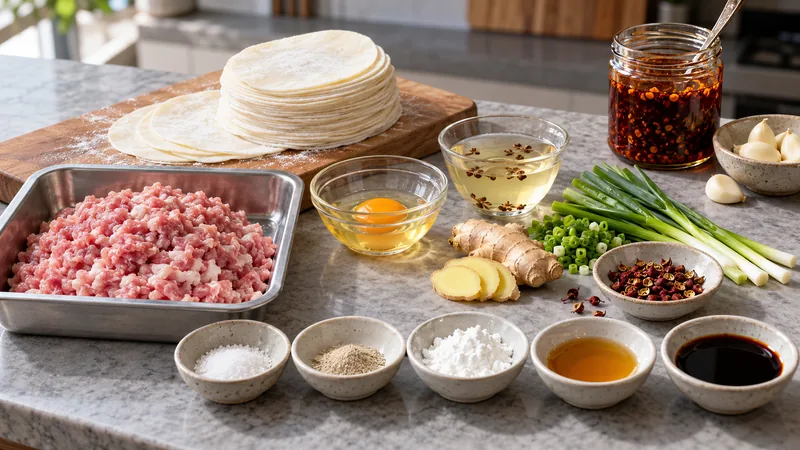
For the filling, measure 400 g pork, 1/2 teaspoon salt, 1/4 teaspoon white pepper, 1 tablespoon Sichuan sweetened soy sauce, 1 egg, 1 tablespoon sesame oil and 2 teaspoons cornstarch. For the infusion, use 1 tablespoon minced scallion, 1 tablespoon minced ginger, 1/2 tablespoon Sichuan peppercorns and 1/2 cup freshly boiled water.
Buy wrappers intended for boiled dumplings rather than assuming any thin pastry has the same strength. Keep spare wrappers covered while working. The source does not give a fixed wrapper count for every diameter; the measured pork batch and small filling portion guide how many wrappers are used. Do not promise an exact yield that the wrapper size cannot support.
Use prepared Sichuan sweetened soy sauce and ready-made red chili oil for the serving dressing. Sweetened soy is not plain soy mixed into an arbitrary preservation recipe. Check labels for soy, wheat, egg and sesame. Plain soy has a different salt and sweetness balance; a substitution changes the dressing rather than reproducing it automatically.
Make the aromatic water and filling
Combine the infusion ingredients in a small bowl and pour over the freshly boiled water. Let it cool before straining, keeping the liquid and removing the solid peppercorns, ginger and scallion. Do not pour boiling liquid into raw pork and egg or leave whole hard spices in the filling by mistake.
Mix pork with salt, white pepper and sweetened soy. Combine the cooled strained liquid and egg with the pork, then stir in sesame oil and cornstarch until the filling holds together. The source uses short pulsed blending; finely ground pork can instead be mixed while retaining some texture. Keep the mixture refrigerated during delays and separate from the sauce bowls and cooked-food utensils.
Check consistency before filling all wrappers. A moist sticky mixture should remain in a small mound rather than flooding the wrapper edge. If using a processor, stop and scrape safely rather than reaching near moving blades. This is recipe preparation, not a claim that seasoning or mixing makes raw pork safe to taste.
Shape small half-moon dumplings
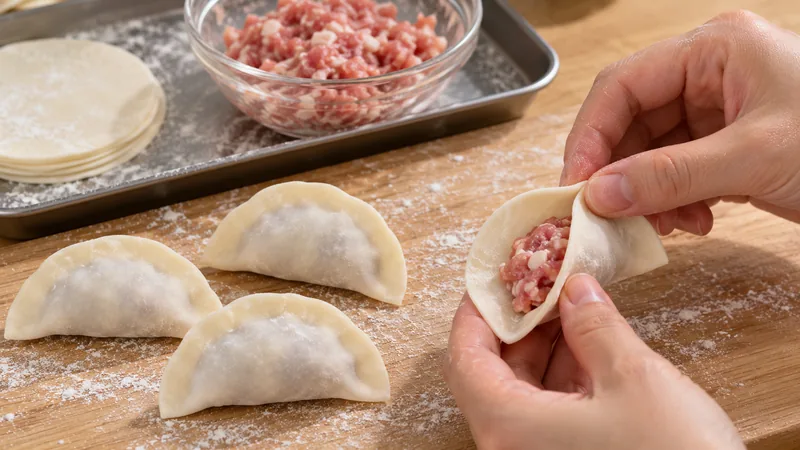
Put about 1/2 tablespoon filling in the middle of a wrapper. For store-bought wrappers, lightly wet the rim as needed, fold into a half moon and press the edges together. Keep filling away from the seal and avoid trapped large air pockets. Do not pack extra meat into a wrapper merely to finish faster.
Lay uncooked parcels apart on a suitable clean surface so they do not stick into a single clump. Make one small batch first and check that the seam holds before shaping the entire filling. Different wrappers may need different rim moisture; soaking the whole wrapper weakens it rather than improving the seal.
Boil and check actual doneness
Bring a roomy pot of water to a boil and add a manageable batch. Stir gently near the start to prevent sticking. Keep the cooking water moving without a destructive boil that tears the wrappers. The source describes returning the pot to a boil and adding water twice, but that rhythm does not replace the filling-temperature check.
Cook until a representative dumpling, especially a larger one, has ground-pork filling at 71°C (160°F). Floating or a translucent wrapper alone does not verify the meat. If a dumpling opens, continue cooking its filling safely and fix the sealing technique for later batches. Do not serve a leaking parcel early merely to keep a tidy plate.
Dress small portions and handle leftovers
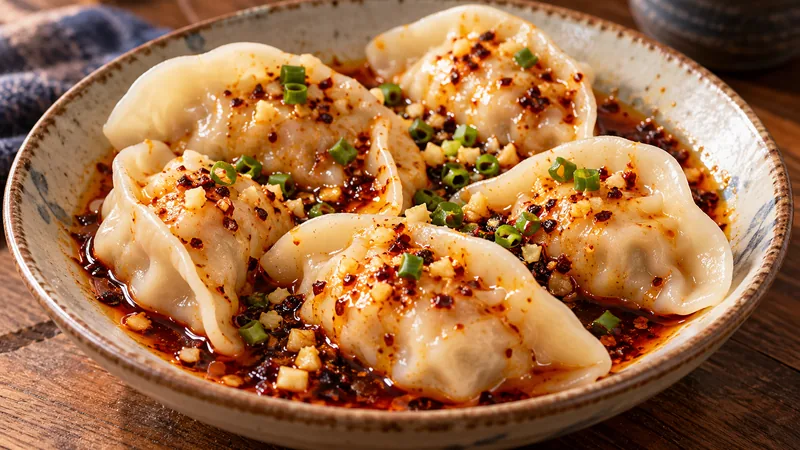
For each serving, mix 1 tablespoon prepared sweetened soy sauce, 1 teaspoon chili oil and 1 teaspoon minced garlic. The source offers optional MSG; it is omitted here. Drain cooked dumplings into the serving bowl and coat gently. Extra chopped scallion is an optional garnish, not an undisclosed vegetable filling.
Serve promptly with clean utensils. Sauce amount should be judged against the actual serving, rather than automatically pouring a single serving’s sauce over the entire 400 g filling batch. The source suggests small portions; wrapper size and appetite vary, so parcel count is a serving guide rather than a safety criterion.
Refrigerate leftovers in shallow containers at 4°C (40°F) or below within two hours, or one hour above 32°C (90°F). Keep advance raw filling refrigerated separately. Reheat cooked leftovers to 74°C (165°F). Garlic dressing and chili oil do not preserve cooked pork at room temperature. The illustrations identify ingredient and shape choices, not an actual kitchen trial.
Quick reference
Cool and strain the infusion, mix the measured pork filling, use small securely sealed parcels, cook the filling completely, then dress each serving separately. No noodle-cooking or cucumber-salting process belongs in this dumpling method.
References
- China Sichuan Food: Zhong dumplings
- FoodSafety.gov: ground-meat temperatures
- FoodSafety.gov: separation and chilling
Frequently Asked Questions
Is this a cabbage filling?
No. This version uses pork and cooled strained aromatic water; it is not a cabbage-heavy dumpling.
How many wrappers are required?
The source does not specify one universal count. It depends on wrapper diameter and the small filling portion; use the measured 400 g filling batch as the quantity basis.
Do floating dumplings prove the pork is cooked?
No. Check representative filling for 71°C (160°F); wrapper appearance and floating alone are insufficient.
Can plain soy replace sweetened soy automatically?
No. The dressing uses prepared Sichuan sweetened soy sauce; plain soy changes its balance.
Can the filling be tasted raw?
No. Assess seasoning only in a fully cooked sample and keep raw filling separate from ready-to-eat food.