Looking for famous Sichuan food chefs? Start with the Chen family’s three generations—Chen Kenmin, Chen Kenichi and Chen Kentaro—and then distinguish their restaurant work from Fuchsia Dunlop’s role as a trained cook and food writer. Together, these examples offer a useful route into how Sichuan cooking is taught and shared across languages and borders. They are a small, documented selection, not a ranking of the world’s best chefs or a complete list of the people who shaped the cuisine.
The names can be confusing because the family shares a surname and because Sichuan is also written Szechwan or Szechuan in English restaurant names. Keep the generation, place and source beside each person. A restaurant’s family account describes its own lineage; a chef’s interview reveals a particular person’s experience; an author’s biography establishes a different kind of professional work. None of those sources alone proves who invented a classic dish.
Compare the people and their contributions
| Person | Documented connection | Useful starting point |
|---|---|---|
| Chen Kenmin | Sichuan-born chef in the Shisen Hanten family history | How cooking travels when ingredients and audiences change |
| Chen Kenichi | Kenmin’s eldest son; chef, educator and television figure in Japan | His own account of learning and demonstrating cooking |
| Chen Kentaro | Third-generation chef associated with Singapore’s Shisen Hanten | Family training alongside time working in Sichuan |
| Fuchsia Dunlop | Cook and writer who trained in Chengdu | English-language recipe writing and culinary explanation |
Use the table to choose what to explore. For restaurant lineage, follow the Chen family. For learning from an English-language text, start with the writer’s books and check the scope of the volume. Fame, teaching skill and restaurant service are related subjects, but they are not interchangeable qualifications.
Chen Kenmin: migration and adaptation in context
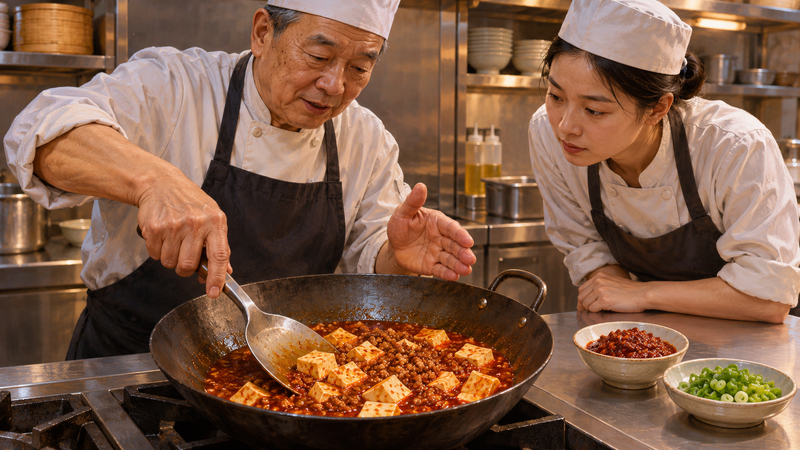
Shisen Hanten’s own history describes Chen Kenmin as born in Sichuan and later settled in Yokohama after cooking elsewhere in China, Hong Kong and Taiwan. That is a family restaurant’s account of its founder’s route. It provides a specific example of culinary migration, rather than evidence that one person created Sichuan food outside China single-handedly.
A more concrete detail appears in Chen Kenichi’s 2011 interview with Tsuji. Recalling his father’s work in Japan, Kenichi discusses the difficulty of finding doubanjiang and explains that his father made it himself. He also recalls adapting dandan noodles for diners there. These are attributed recollections, useful precisely because they show a constraint and a response rather than an abstract claim about “authenticity.”
When comparing a Japanese Sichuan dish with a Chengdu version, ask what changed: an ingredient, a serving format, the balance of the sauce, or the expectations of the diner. A difference need not be hidden, and a family adaptation need not be promoted as the original version of every dish. Name the version before deciding what to reproduce in your own kitchen.
Chen Kenichi: watch what a teacher makes visible
The Tsuji interview identifies Kenichi as Kenmin’s eldest son and places his public work across restaurants, television and teaching. The conversation is dated January 28, 2011. Its descriptions of his responsibilities belong to that moment; they should not be copied as a current restaurant staffing announcement.
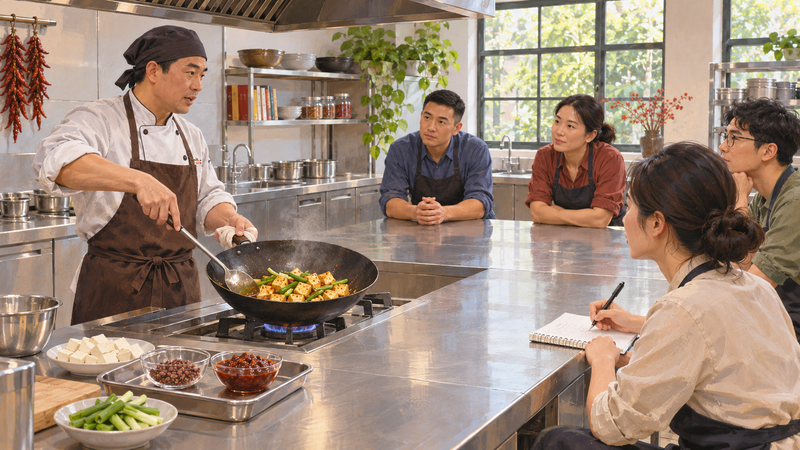
One valuable teaching detail is his emphasis on bringing students close enough to notice cooking’s smells and sounds. Paraphrased from his interview, that observation redirects a learner’s attention from a list of minutes toward sensory evidence. It is not permission to ignore a recipe’s safety instructions. It is a reason to notice what a written direction such as “fry until fragrant” asks you to observe.
When watching a demonstration, record the sequence: when the paste enters the pan, when liquid is added, and how the cook moves fragile ingredients. Keep the demonstrator’s version attached to your notes. A television persona may introduce you to a cook; the reproducible actions in a complete lesson are what help you learn the dish.
Chen Kentaro: family training and work in Sichuan
The restaurant’s chef profile identifies Kentaro as the third generation and records work in Sichuan restaurants from 2005 to 2008. It connects him with the Singapore restaurant launched in 2014. Those details let a reader distinguish him from his father and grandfather without relying on a photograph or a similar-sounding name.
The useful comparison is between two learning settings: observing a family kitchen and working in the region associated with the cuisine. Neither setting makes every later dish identical. Read a named menu or recipe as a particular restaurant’s expression, and check which chef, venue and date the page actually concerns.
This distinction also keeps travel plans separate from culinary history. A historical profile does not confirm today’s opening hours, menu, chef attendance or awards. Use the restaurant’s current information when making a booking; use the dated sources here to follow the learning lineage.
Fuchsia Dunlop: a cook-writer’s route into learning
On her own biography page, Fuchsia Dunlop describes training as a chef at the Sichuan Higher Institute of Cuisine in Chengdu in the 1990s and researching Chinese food traditions. Her work is particularly relevant to readers who want to move between English explanations and Chinese ingredients. This is a cook-writer’s contribution, rather than the same restaurant-family role as the Chen lineage.
Her book list includes The Food of Sichuan, as well as works with different regional or thematic scopes. A book about Chinese food is not automatically a book only about Sichuan. Check the title, contents and introduction before assuming that every recipe belongs to the same regional tradition.
For practical reading, mark the Chinese ingredient name beside its English equivalent and notice whether the author offers a substitution or explains a technique. Try one complete recipe before combining instructions from several sources. If you change the ingredients or pan, note that change rather than attributing the result unchanged to the author.
Choose a source for the question you actually have
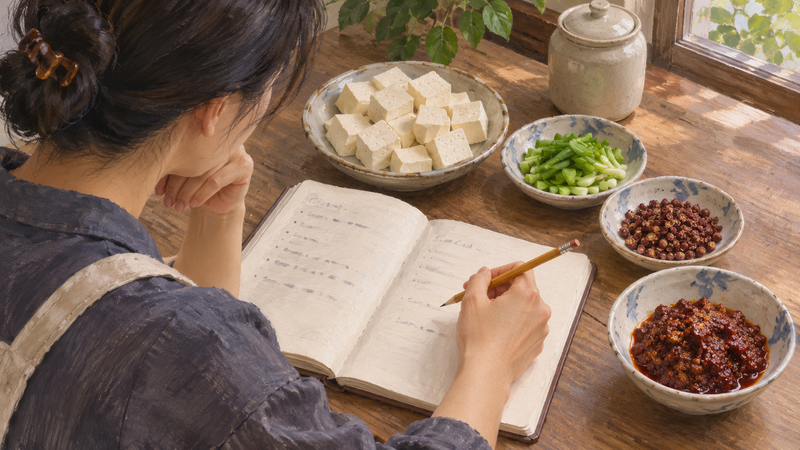
For a person’s training, look for a dated interview or biography. For a restaurant dish, look for the venue’s own menu or a clearly credited recipe. For a technique, seek a complete demonstration or tested written method. A flattering nickname, award badge or viral clip cannot supply all three kinds of information.
These profiles are an entry point into a much wider food culture. They leave out many regional chefs, teachers and home cooks, so absence here is not a judgment of importance. Continue with our Sichuan cuisine history timeline for a broader frame, or the mapo tofu sauce guide when your next question concerns a concrete cooking task.
Questions about these Sichuan food figures
Are Chen Kenmin, Kenichi and Kentaro the same person?
No. In the cited family history, Kenmin is the founder-generation chef, Kenichi his eldest son, and Kentaro the third-generation chef. Keep the given name with the surname when searching.
Is this a ranking of the most famous Sichuan chefs?
No. It is a source-based selection showing different routes of teaching and sharing the cuisine. It does not measure fame, compare skill or represent every regional tradition.
Does a family restaurant version define the only authentic recipe?
No. Read a version in its named context. The cited interview itself discusses adaptation to ingredient availability and diners; that is a reason to preserve context rather than erase differences.