Quick answer: A vegan Sichuan hot pot needs more than vegetables in a red broth. Verify the broth base, chili bean paste, seasoning powder, sauces, noodles, and dipping condiments; replace animal fat with neutral oil; build depth with mushrooms and optional kelp; and use tofu, mushrooms, roots, greens, and noodles in separate cooking rounds. “Vegan” does not automatically mean gluten-free, soy-free, sesame-free, or allergen-free.
This is a flexible home plan, not one canonical Chengdu formula. Sichuan hot pot varies by household, restaurant, broth style, spice level, and commercial base. The goal here is to preserve a layered chili-peppercorn profile while making every ingredient choice visible and controllable.
For a mixed table, use a divided pot or a truly separate pot when non-vegan food is present. Separate ladles and chopsticks help reduce accidental transfer, but they cannot make a shared boiling broth vegan again after animal ingredients enter it. For a diner with a serious food allergy, a divided “yin-yang” pot and separate serving spoons are not a reliable cross-contact guarantee: shared preparation surfaces, hands, utensils, splashes, and ingredient containers can transfer allergen. Use a separately prepared meal and equipment that meet the diner’s medical guidance and applicable local rules.
Check the labels before you heat the pot
| Item | What may need checking | Practical alternative |
|---|---|---|
| Packaged hot pot base | Beef fat, chicken powder, meat extract, dairy, or unclear flavoring | Build the broth from oil, aromatics, chili paste, mushrooms, and stock |
| Chili bean paste | Ingredient list, wheat, processing aids, regional recipe | Choose a clearly labeled product that fits the diners’ needs |
| Stock or seasoning | Chicken, fish, shellfish, dairy, or animal-derived flavor enhancer | Plain vegetable or mushroom stock |
| Soy sauce and noodles | Wheat and soy | Use verified alternatives only if required |
| Sesame paste or oil | Sesame allergen | Offer a separate sesame-free dipping bowl |
In the United States, FDA major-allergen labeling includes wheat, soybeans, and sesame—three ingredients that can appear at a hot pot table. Ingredient labels and advisory statements do not remove the need to consider cross-contact. If a diner has a serious allergy, follow their medical guidance and the relevant local rules rather than relying on a general recipe.
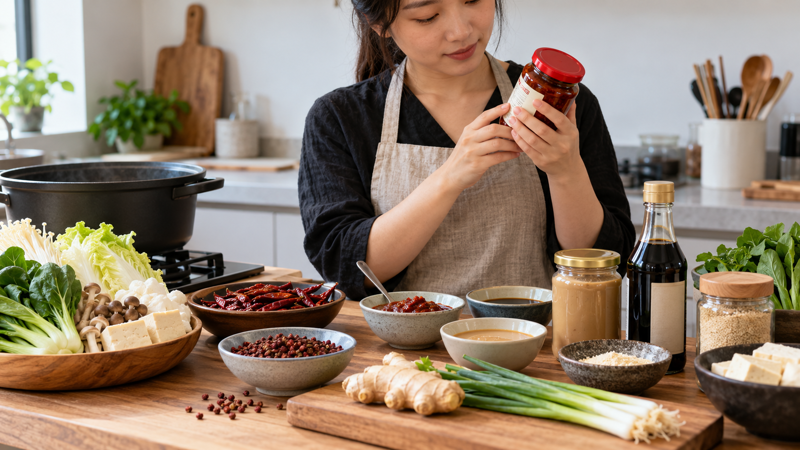
A flexible vegan Sichuan-style broth
For a 3- to 4-quart pot serving four, use this as a starting formula: 6 cups / 1.4 L unsalted vegetable or mushroom stock, 3 tablespoons neutral oil, 2 tablespoons clearly vegan chili bean paste, 1 tablespoon fermented black beans if suitable, 6 to 12 dried chilies, 1 to 2 teaspoons whole red Sichuan peppercorns, 5 slices ginger, 4 crushed garlic cloves, 3 scallion sections, and 1 teaspoon sugar. Optional dried shiitake and a small piece of kelp can deepen the broth; remove the kelp before a long boil if its texture or bitterness becomes distracting.
Toast the dried chilies and peppercorns gently in the oil until fragrant, not black. Add ginger, garlic, scallion, paste, and black beans, then stir until the oil is aromatic. Add stock slowly and simmer 15 to 20 minutes. Taste before salting because pastes and sauces vary widely. Add more chili for heat, more peppercorn for numbing aroma, and more stock if the base becomes harsh or salty.
This ratio is deliberately lighter than an oil-dominant restaurant broth. It is an adaptable home formula, not a claim of restaurant equivalence. Our broader Sichuan hot pot communal-meal guide explains the table format; this page focuses on the vegan gate.
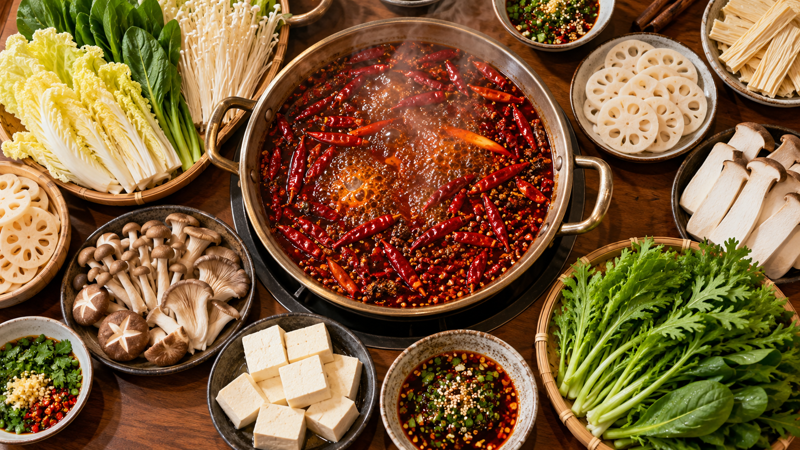
Choose ingredients by cooking time
| Group | Examples | Preparation | When to add |
|---|---|---|---|
| Firm and slow | Potato, lotus root, daikon, winter melon | Slice evenly; keep potato in water until serving | First, in small batches |
| Protein and absorbent | Firm tofu, fried tofu puffs, tofu skin, seitan if suitable | Drain; verify packaged ingredients and allergens | Early to middle |
| Mushrooms | Shiitake, oyster, shimeji, enoki | Trim and separate; cook thoroughly | Middle |
| Quick vegetables | Napa cabbage, bok choy, chrysanthemum greens, spinach | Wash and drain well | Late |
| Starch | Rice noodles, glass noodles, wheat noodles | Check label; soak if package directs | Last, after broth is seasoned |
Do not load every ingredient at once. Crowding cools the pot, muddies textures, and makes it hard to see what is cooked. Keep raw produce on clean platters, add manageable batches, and return the broth to an active simmer between rounds.
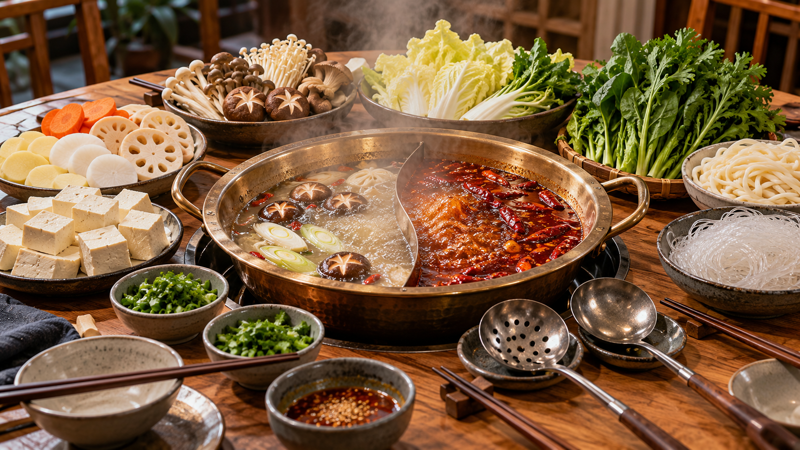
Cook in three rounds
- Build the base. Start with roots, firm tofu, and sturdy mushrooms. Let the broth recover its simmer before adding more.
- Fill the middle. Add tofu skin, cabbage, and tender mushrooms in portions. Remove food when its texture is ready instead of leaving everything in the pot.
- Finish light. Add leafy greens and noodles near the end. They cook quickly and can absorb salt from a concentrated broth.
Keep a small jug of hot unsalted stock nearby. As the meal continues, evaporation and packaged sauces can make the broth increasingly salty. Dilute first, then adjust chili or peppercorn aroma separately.
Build a dipping sauce separately
For each diner, offer a simple base of 1 tablespoon soy sauce or a verified alternative, 1 tablespoon sesame paste thinned with warm water or a sesame-free substitute, 1 teaspoon black vinegar, chopped scallion, cilantro, minced garlic, and a spoon of broth. Let each person choose chili oil rather than making every bowl equally hot.
Use clean, dedicated spoons for each condiment. The Food Standards Agency notes that utensils, surfaces, storage, and service can all create allergen cross-contamination. A “vegan” ladle that has entered an animal broth is no longer suitable for the vegan pot. The same principle applies to allergen-specific utensils.
Temperature boundary: USDA guidance says hot food held for service should stay at or above 140°F / 60°C. At home, keep the pot actively hot during the meal and do not use warm appearance alone as a safety check.
Perishable foods should not remain at room temperature for more than two hours, or one hour in temperatures above 90°F / 32°C, under USDA buffet guidance. Bring out small platters and replenish them instead of placing the entire supply on the table at once.
For leftovers, strain solids from broth, divide large quantities into shallow containers, and refrigerate within two hours—or within one hour when the air temperature is above 90°F / 32°C. Keep the refrigerator at 40°F / 4°C or below, use refrigerated leftovers within 3 to 4 days or freeze them sooner, and reheat leftovers to 165°F / 74°C before serving; bring the broth to a boil and check solid pieces in several places. Do not keep repeatedly topping up the same pot across days. Discard food when time or handling is uncertain; smell is not a reliable safety test.
Questions about vegan Sichuan hot pot
Is Sichuan hot pot broth usually vegan?
No assumption is safe. Some bases use beef fat, meat stock, chicken powder, fish or shellfish flavoring, or dairy. Verify the ingredient list or build the broth yourself.
How do I replace beef fat in hot pot broth?
Use neutral oil for carrying chili and peppercorn aroma, then add mushroom stock, dried shiitake, fermented ingredients, and aromatics for depth. The result will not copy beef-fat texture exactly, so treat it as a deliberate vegan broth.
Can vegan hot pot be gluten-free?
It can be planned that way, but vegan status alone says nothing about gluten. Check chili paste, soy sauce, seasoning, noodles, tofu products, and shared utensils against the diner’s needs.
What should go into the pot first?
Start with slow-cooking roots, firm tofu, and sturdy mushrooms. Add cabbage and tender mushrooms next, then leafy greens and noodles last.
Sources and safety notes
- U.S. FDA: Food Allergies and labeling
- UK Food Standards Agency: allergen guidance and cross-contamination
- USDA FSIS: hot holding at 140°F / 60°C or above
- USDA FSIS: buffet time and temperature guidance
- FoodSafety.gov: refrigerating and reheating leftovers
Boundary: This page provides a home planning framework. Product formulas, allergen rules, and public-health requirements vary; check current labels and local guidance.