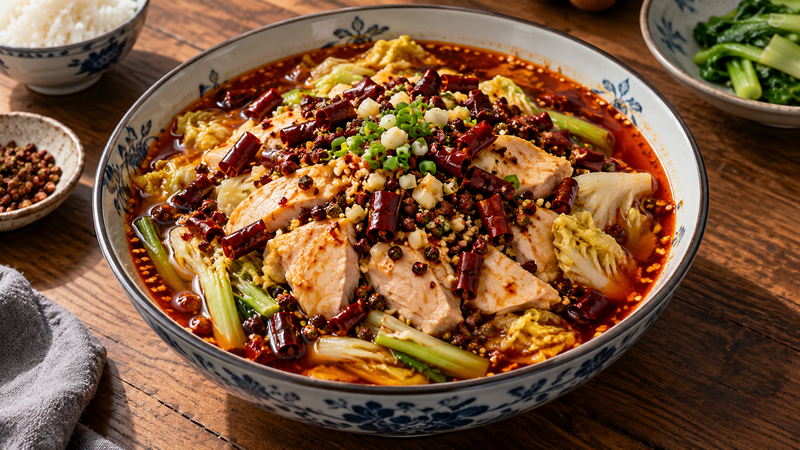
Quick answer: Sichuan boiled chicken, or 水煮鸡片 (shuǐ zhǔ jī piàn), is not plain chicken simmered in water. Thin marinated chicken slices cook gently in a doubanjiang-seasoned broth over vegetables, then receive dried chilies, Sichuan peppercorns, garlic, scallions, and a controlled pour of hot oil.
If you searched for “Sichuan chicken boiled,” this is the dish you are probably trying to find. The English word boiled describes the broader shui zhu family, but the home method uses several heat stages. Vegetables form the base, doubanjiang flavors the broth, chicken cooks gently rather than at a violent boil, and a small aromatic oil finish wakes up the dry spices.
This version serves four with rice. It is a home adaptation built around ingredients available in many international supermarkets. Doubanjiang brands vary in salt, heat, texture, wheat content, and fermentation character, so taste the broth before adding extra salt.
What Sichuan boiled chicken means
The dish borrows the structure of better-known shui zhu beef or pork: a vegetable bed, a red seasoned broth, tender starch-coated meat, and a final chili-peppercorn aroma layer. The chicken is a protein variation, not a claim that every Sichuan restaurant uses one identical formula.
Our spicy boiled pork slices document the same method with pork. The Sichuan boiled beef recipe is the closer traditional reference. This page gives chicken its own timing, slicing, and food-safety instructions rather than telling you to swap proteins blindly.
Ingredients and substitutions
| Part | Ingredient | Amount | Function or substitution |
|---|---|---|---|
| Chicken | Boneless skinless breast or thigh | 1 lb / 450 g | Breast is leaner; thigh is more forgiving. Slice either evenly. |
| Marinade | Shaoxing wine, light soy sauce, white pepper, salt | 1 tbsp, 1 tsp, 1/4 tsp, 1/4 tsp | Dry sherry can replace wine; check soy and wheat labels as needed. |
| Coating | Cornstarch and cool water | 1 1/2 tbsp, 2 tbsp | Creates a thin protective coating; potato starch also works. |
| Cooking oil | Neutral oil | 5 tbsp plus 1 tsp total | Use 1 tsp in the chicken coating, 1 tbsp for the vegetables, 1 tbsp to fry the doubanjiang, and 3 tbsp for the final aromatic pour. |
| Vegetables | Napa cabbage and celery | 10 oz / 280 g total | Bean sprouts or bok choy can replace part of the cabbage. |
| Broth | Low-sodium chicken stock or water | 4 cups / 950 ml | Unsalted stock gives the most control. |
| Seasoning | Doubanjiang | 2 tbsp, finely chopped | Reduce for a salty brand; do not replace with sweet chili sauce. |
| Aromatics | Ginger and garlic | 1 tbsp each, minced | Divide the garlic between broth and topping. |
| Dry spices | Dried chilies and Sichuan peppercorns | 8–12 chilies; 1–2 tsp peppercorns | Adjust heat and numbing aroma separately. |
| Optional balance | Sugar | Up to 1 tsp | Add only after tasting if the paste is sharply salty or bitter. |
| Finish | Scallions | 2 scallions | Slice for the topping; the 3 tbsp finishing oil is included in the total oil row above. |
Doubanjiang and soy sauce may contain wheat or soy; some stocks and spice blends have additional allergens. Read the exact package rather than assuming all products share one formula. If egg is used in another velveting method, treat it as an additional allergen; this recipe does not need egg.
Slice and marinate the chicken
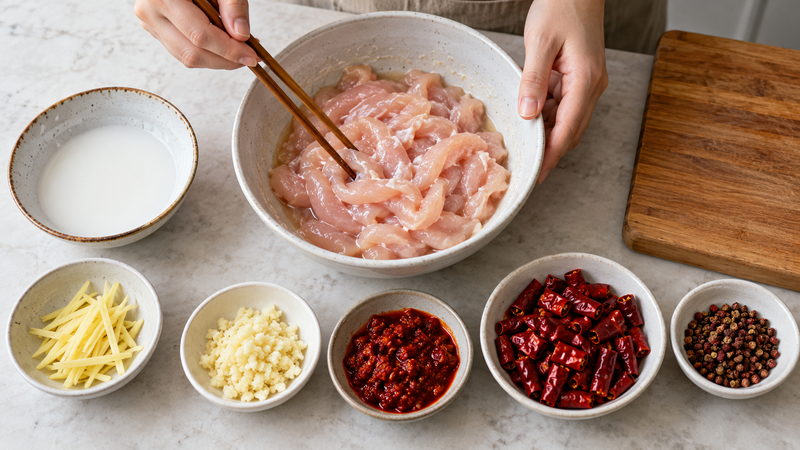
- Pat the chicken dry. Slice across the grain into pieces about 1/8 inch / 3 mm thick. If the breast is very soft, chill it for 15 minutes to make even slicing easier; do not freeze it solid.
- Mix chicken with Shaoxing wine, soy sauce, white pepper, and 1/4 teaspoon salt. Add cornstarch and cool water, mixing until no dry starch remains. Stir in 1 teaspoon neutral oil.
- Cover and refrigerate for 15 to 20 minutes while you prepare the vegetables and broth. Do not leave raw poultry on the counter for an extended marinade.
The coating should look thin and clingy, not like batter. Too much starch makes the broth gummy; too little water leaves dusty patches. Even thickness matters more than chasing paper-thin slices.
Build the vegetable bed
Cut napa cabbage into bite-size pieces and celery on a diagonal. Heat 1 tablespoon neutral oil in a wide wok or pot. Stir-fry the celery for one minute, then add cabbage with a pinch of salt. Cook until the stems are crisp-tender and the leaves collapse, about 2 to 3 minutes. Transfer everything to a deep, heatproof serving bowl.
The vegetables should be cooked but not waterlogged. They will receive hot broth later. If you use bean sprouts, cook them separately until thoroughly cooked before they go into the serving bowl; do not use smell as a safety test or rely on the later ladle of hot broth to finish them. FDA guidance for pregnant people—one group at higher risk from foodborne illness—says to avoid raw sprouts and cook sprouts thoroughly. For higher-risk diners, use only thoroughly cooked sprouts or omit them. A sturdy bed keeps the chicken near the surface and gives the bowl texture beneath the chili oil.
Make the spicy broth
Return the pot to medium heat with 1 tablespoon oil. Add finely chopped doubanjiang and stir for 60 to 90 seconds, until the oil turns red and smells fermented rather than raw. Add half the garlic and all the ginger; stir for 20 seconds without browning the garlic.
Pour in stock slowly and scrape up the seasoning. Simmer for 5 minutes. Taste the liquid: it should be savory and slightly stronger than a sipping soup because the vegetables and chicken will dilute it. Add up to 1 teaspoon sugar only if the paste tastes sharply salty or bitter. Do not add more salt until after tasting.
Cook the chicken gently
Lower the broth to a gentle simmer. Add chicken slices one at a time or in loose handfuls, separating folds with chopsticks. Leave them undisturbed for 20 seconds so the coating sets, then stir gently.
Cook until every piece reaches 165°F / 74°C on a food thermometer. For thin, even slices this usually takes 3 to 5 minutes after the broth returns to a gentle simmer, but time is not the safety test. The FDA lists 165°F for poultry, and color alone cannot confirm doneness.
Turn off the heat as soon as the endpoint is reached. Ladle chicken and enough broth to surround it over the vegetable bed. You do not need to transfer every drop; a deep pool is useful, but the dish should not become an oversized bowl of salty soup.
Finish with chili and peppercorn oil
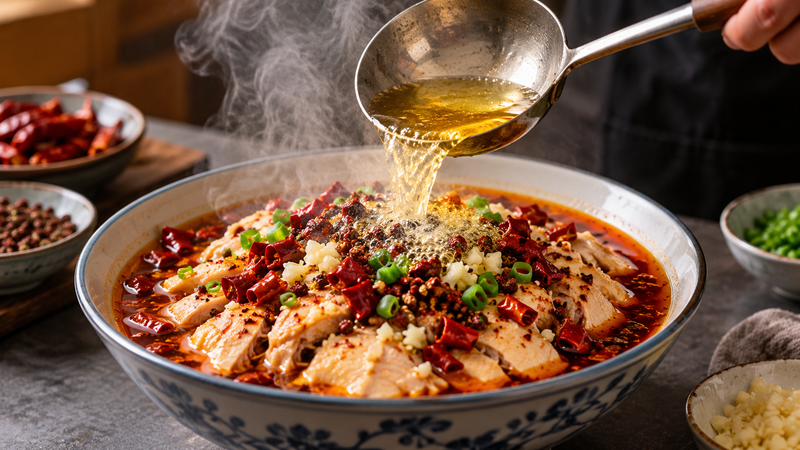
Coarsely crush the Sichuan peppercorns. Cut dried chilies into short sections and shake out some seeds if you want less heat. Place peppercorn, chilies, remaining garlic, and sliced scallions on top of the fully cooked chicken.
Heat the final 3 tablespoons oil in a small pan until shimmering but not smoking. Remove it from the heat and pour it slowly over the garnish. The topping should sizzle without violent splashing. Use a stable heatproof bowl, keep water away from the hot oil, and never pour from shoulder height.
Serve immediately with plain rice. For a second use of chili oil and numbing aroma in a smaller format, see the Sichuan chili oil wontons.
Troubleshooting
| Problem | Likely cause | Next time |
|---|---|---|
| Chicken is dry | Slices were uneven or boiled hard after reaching temperature | Slice evenly, use a gentle simmer, and stop at 165°F / 74°C. |
| Coating falls off | Chicken entered a rolling boil or was stirred immediately | Lower the heat and let the coating set for 20 seconds. |
| Broth is too salty | Doubanjiang, soy sauce, and stock were all highly seasoned | Use unsalted stock, reduce paste, and taste before salting. |
| Dish is hot but not fragrant | Chilies burned or peppercorns were stale | Use fresh spices and oil that shimmers without smoking. |
| Broth is gummy | Too much starch or too much loose marinade entered the pot | Use a thin coating and separate slices before cooking. |
Storage and reheating
Refrigerate leftovers in shallow covered containers within two hours of cooking, or within one hour when the surrounding temperature is above 90°F / 32°C. Keep at 40°F / 4°C or below and use cooked poultry leftovers within 3 to 4 days under FDA guidance.
Reheat only the portion you plan to eat, bringing the chicken and broth back to 165°F / 74°C. Expect the cabbage to soften and the chicken coating to become less delicate. Do not judge safety by smell alone, and discard leftovers when timing or refrigeration is uncertain.
Raw-poultry boundary: Wash hands, knife, board, bowl, and thermometer probe after contact with raw chicken. Keep sliced scallions and other ready-to-eat garnishes away from raw-poultry tools.
Questions about Sichuan boiled chicken
Is Sichuan boiled chicken actually boiled?
It belongs to the shui zhu, or “water-boiled,” family, but a rolling boil is not the goal for thin chicken. The seasoned broth simmers gently, and a separate hot-oil finish adds aroma.
Can I use chicken thigh instead of breast?
Yes. Boneless thigh has more fat and is forgiving, while breast gives cleaner slices. Remove large tendons, slice evenly, and cook either cut to 165°F / 74°C.
How do I keep the chicken tender?
Slice across the grain, use a thin cornstarch-water coating, add the pieces to a gentle simmer, and stop cooking once they reach the safe endpoint. Hard boiling and long holding dry the meat.
How spicy is this recipe?
It is medium-hot with 8 dried chilies and hotter with 12, depending on the variety. Reduce dried chilies for less heat while keeping some Sichuan peppercorn for aroma; the two sensations are adjustable separately.
Sources and safety boundary
- My Sichuan Food: the broader spicy boiled-slices method
- U.S. FDA: safe food handling and 165°F poultry endpoint
- U.S. FDA: food-safe recipe and leftover guidance
- U.S. FDA: food allergen labeling
- U.S. FDA: sprout safety for people at higher risk during pregnancy
Boundary: Ingredient brands and equipment change salt, heat, and timing. Use the stated temperature and current product labels rather than appearance or a fixed minute count alone.