Sichuan beef dry pot is a broth-free wok dish built in stages: pre-cook and dry the firm vegetables, sear marinated beef separately, fry the aromatic base, then toss everything together briefly so the seasoning clings instead of pooling.
This page gives one small home formula. It is not presented as the only regional version or as a documented kitchen trial. The useful part is the sequence: each ingredient reaches the wok in the state it needs, and the final toss stays short.
What makes this a beef dry pot
A dry pot is not a pot without seasoning. The word “dry” describes the absence of a simmering broth: the beef and vegetables carry a light, concentrated coating of doubanjiang, aromatics, dried chile and Sichuan pepper. The ingredients should remain recognizable instead of floating in sauce.
This article is narrower than our general Sichuan dry pot guide, which discusses a mixed-ingredient version. It is also different from our celery and pickled-chili Sichuan beef stir-fry. Here, the beef is paired with firm vegetables, and moisture control matters as much as wok heat.
- Yield
- 3 to 4 portions with rice
- Beef
- 350 g whole-cut beef, sliced across the grain
- Vegetables
- About 400 g total lotus root, cauliflower and celery
- Core seasoning
- Doubanjiang, dried chile, Sichuan pepper, garlic and ginger
- Texture target
- Tender beef, crisp vegetables and a clinging coating with no broth pool
- Evidence boundary
- An editorial home formula, not a universal Sichuan standard or a recorded cooking test
The ingredients below leave room for product differences. Doubanjiang, soy sauce and dried chiles vary in salt and heat. Measure a starting amount, read the labels, then adjust only after the ingredients have been combined.
Ingredients for a small home batch
For the beef:
- 350 g flank steak or sirloin from a whole cut, trimmed and sliced across the grain into strips about 4 mm thick
- 1 tablespoon light soy sauce
- 1 tablespoon Shaoxing wine or water
- 1 1/2 teaspoons cornstarch
- 1 teaspoon neutral cooking oil
For the vegetables and dry-pot base:
- 150 g lotus root, peeled and cut into thin rounds
- 150 g cauliflower, divided into small florets
- 100 g celery, cut into short batons
- 3 tablespoons neutral cooking oil, divided as the pan requires
- 1 to 1 1/2 tablespoons doubanjiang
- 6 dried red chiles, cut into sections; use fewer for a milder batch
- 1 teaspoon whole Sichuan peppercorns, lightly crushed
- 3 garlic cloves, sliced
- 15 g fresh ginger, cut into thin slices or matchsticks
- 2 scallion whites, cut into short sections, plus green parts for finishing
- 1 teaspoon light soy sauce, only if the combined dish needs it
- 1/2 teaspoon sugar
- 1 teaspoon toasted sesame oil, optional
Soy sauce and many doubanjiang products contain soy and wheat; some prepared sauces have additional allergens. Check every jar and bottle rather than assuming the ingredient list is identical across brands. The marinade quantity is a starting formula and does not make raw meat safe to taste.
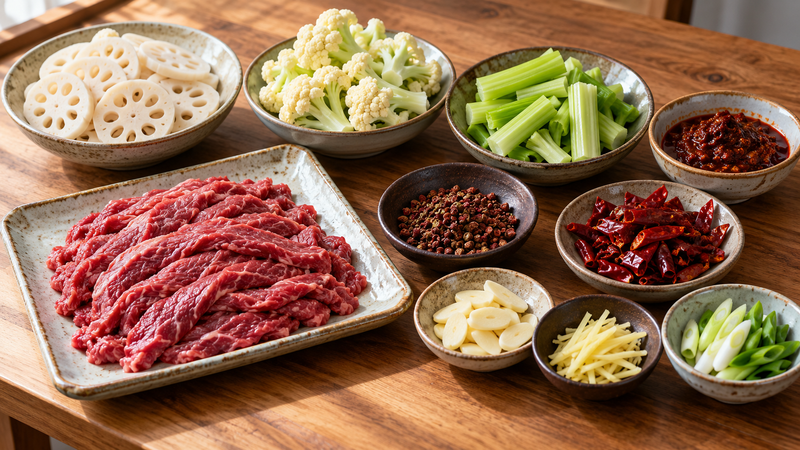
Prepare every component before the wok
Step 1 · Separate the raw beef
Do not wash the beef. Slice it on a board reserved for raw meat, place it in a clean bowl, and wash your hands, knife, board and nearby surfaces after contact. The USDA explains that washing raw beef can spread contamination around the kitchen; cooking to the correct temperature is the safety step. See its guidance on washing meat and preventing cross-contamination.
Mix the beef with the tablespoon of soy sauce, wine or water, cornstarch and teaspoon of oil. Cover and refrigerate it for about 15 to 20 minutes while the vegetables are prepared. This short marinade is for seasoning and surface texture, not for food safety.
Step 2 · Pre-cook the firm vegetables
Bring a saucepan of water to a steady boil. Cook the lotus root for about 2 minutes, then add the cauliflower for the final 60 to 90 seconds. These are starting times for thin lotus-root rounds and small florets; thicker pieces need longer. The goal is just-tender vegetables that will finish in the wok.
Drain them thoroughly and spread them on a clean tray or towel so steam can escape. Keep the celery raw for the wok. Water trapped in florets or pooled under lotus root is one of the main reasons a final dry-pot toss becomes a simmer.
Step 3 · Make the cooking line
Set out the doubanjiang, dried chiles, crushed peppercorns, garlic, ginger, scallion whites, sugar and optional finishing oil. Keep a clean plate ready for cooked beef. Do not reuse the raw-beef bowl or its utensils for cooked food unless they have been washed.
Cook the beef and build the dry-pot base
Step 4 · Sear in manageable batches
Heat a wok or broad skillet over medium-high heat, then add enough oil to coat the cooking surface. Spread in half of the beef instead of piling the full amount into a small pan. Turn the strips as they brown, transfer them to the clean plate, and repeat with the remaining beef.
Seconds alone cannot prove doneness because pans, burners and slice thickness differ. For beef cut from a whole steak, the USDA minimum is 145°F / 63°C followed by a 3-minute rest. Use a thermometer suited to thin pieces and check the thickest accessible portion. The rest can occur while you build the aromatic base, but the beef must reach the applicable endpoint before serving. The official USDA safe-temperature chart also distinguishes whole-cut beef from ground beef.
Step 5 · Fry the base without scorching it
Lower the heat to medium. Add a little more oil if the wok is dry, followed by the dried chiles and crushed Sichuan peppercorns. Stir briefly until aromatic. Add garlic, ginger and scallion whites, then the doubanjiang. Keep everything moving for about 30 to 60 seconds, just until the paste colors the oil and smells cooked rather than raw.
Do not keep the burner at maximum while garlic and bean paste sit still. High heat is useful for searing beef; the aromatic stage needs enough control to avoid blackened chiles, bitter garlic and burned paste.
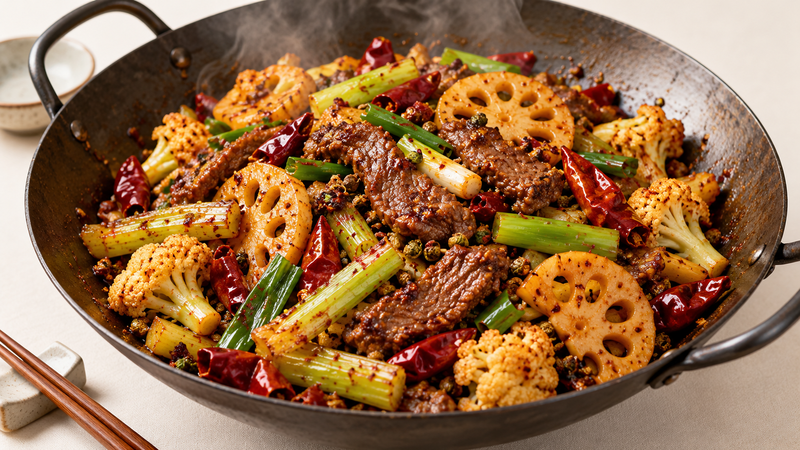
Keep the final toss dry and balanced
Step 6 · Add vegetables in texture order
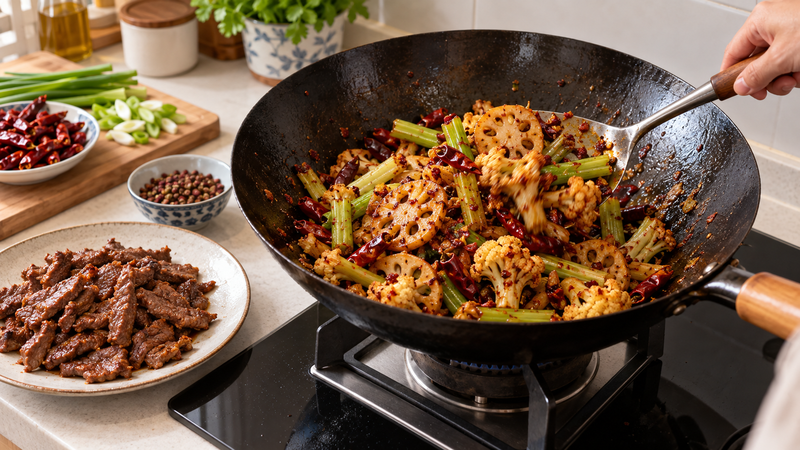
Raise the heat to medium-high. Add the raw celery first and toss until it loses its raw edge but remains crisp. Add the drained lotus root and cauliflower next. Spread the vegetables through the aromatic base so they pick up a thin coating.
Return the cooked beef and any clean resting juices. Add the sugar and toss for a brief final minute. Taste before adding the last teaspoon of soy sauce because the doubanjiang and marinade may already provide enough salt. Turn off the heat, add the optional sesame oil and scallion greens, and transfer the food out of the hot wok.
If the seasoning catches before the vegetables are coated, add one or two teaspoons of water around the side of the wok, not a ladleful. That small amount can loosen the paste without converting the dish into a sauce. If a visible pool remains, keep the mixture moving over heat before returning the beef, rather than overcooking the beef while waiting for water to evaporate.
If the result is watery: check whether the vegetables were drained and whether the wok was crowded.
If the beef is tough: check slice thickness, batch size and the length of the final toss.
If the base tastes bitter: the dried chiles, garlic or doubanjiang may have scorched during the aromatic stage.
If the dish is too salty: note the labels and reduce soy or doubanjiang in the next batch; adding more chile will not remove salt.
Food safety, storage and source notes
This recipe uses beef sliced from a whole cut. The cited USDA endpoint is 145°F / 63°C with a 3-minute rest. Ground beef is a different ingredient and has a 160°F / 71°C minimum; do not carry the whole-cut endpoint over to a ground-beef variation. Appearance and a dark doubanjiang coating are not substitutes for a suitable food thermometer.
Serve the dry pot promptly. Refrigerate leftovers in shallow containers within 2 hours, or within 1 hour when the surrounding temperature is above 90°F / 32°C. The USDA advises keeping refrigerated leftovers for 3 to 4 days and reheating leftovers to 165°F / 74°C. See USDA leftovers guidance for the full handling rules.
- USDA FSIS safe minimum internal temperatures: whole-cut beef, ground beef and thermometer checks.
- USDA FSIS washing-food guidance: raw-meat separation, cleaning and why washing beef is not a safety step.
- USDA FSIS leftovers guidance: prompt cooling, shallow containers and refrigerated storage.
Questions about Sichuan beef dry pot
Is Sichuan beef dry pot the same as hot pot?
No. Hot pot centers on ingredients cooked in simmering broth, often at the table. This dry-pot method pre-cooks components and gives them a concentrated coating in the wok, with no serving broth.
Can I use ground beef?
You can create a separate ground-beef variation, but it will not have the same sliced-beef texture or cooking sequence. Ground beef must reach 160°F / 71°C, and you may need to remove excess rendered fat before building the aromatic base.
How do I keep the dry pot from turning watery?
Drain and spread the blanched vegetables, keep the batch small enough for the pan, and add the beef back only for the final toss. Water can be added by the teaspoon if the paste catches; it should not form a broth.
Do I need a wok?
No. A broad, heavy skillet can work if it gives the beef enough surface contact. Cook in batches, control the heat during the aromatic stage, and move the finished dish out of the pan promptly.