Quick answer
The best quick Sichuan recipes are dishes with a short cooking stage and ingredients that can be measured before the pan gets hot. Smashed cucumber salad, mapo tofu, dan dan noodles, and kung pao chicken all fit a weeknight plan, but they are quick in different ways. Cucumber needs no stove. Noodles rely on bowl assembly. Tofu simmers briefly. Chicken needs careful cutting, sauce preparation, and a verified safe endpoint.
For the easiest dinner, choose one hot main plus one cold side, prepare every sauce first, and cook rice before the wok dish. The time ranges below are planning estimates rather than guarantees; knife work, burner strength, pan size, and the detailed recipe you follow will change the total.
Choose the right quick dinner route
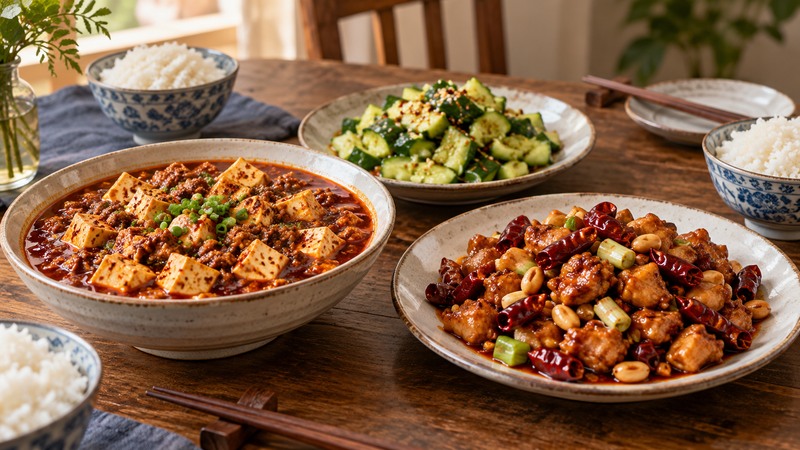
| Route | Best when | Main work | Practical planning range |
|---|---|---|---|
| Smashed cucumber salad | You need a cold side with no stove | Smash, salt briefly, drain, dress | About 10–15 minutes |
| Dan dan noodles | You have chili oil and preserved ingredients ready | Mix sauce, cook noodles, assemble bowls | About 20–30 minutes |
| Mapo tofu | You want one pan and a rice-friendly main | Brown topping, fry doubanjiang, simmer tofu, thicken | About 25–35 minutes |
| Kung pao chicken | You want a fast stir-fry and can prep fully first | Marinate, mix sauce, stir-fry in sequence | About 30–40 minutes |
If you are new to the pantry, begin with the site’s Sichuan recipes for beginners. It organizes dishes by the skill they teach rather than treating every spicy recipe as interchangeable.
Build one fast Sichuan pantry
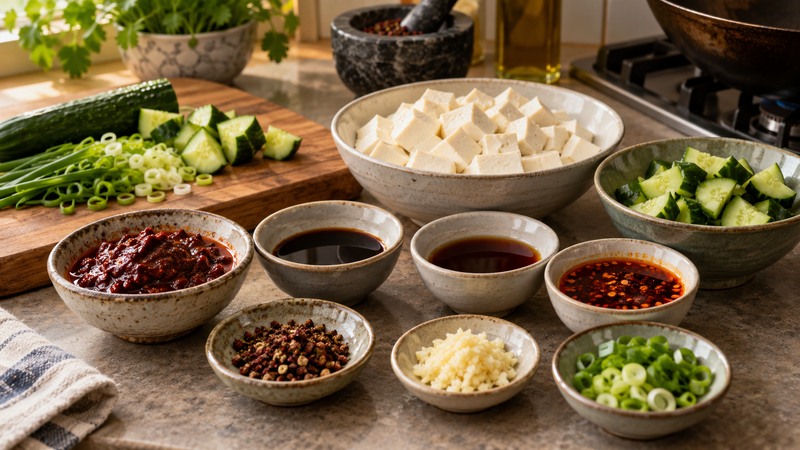
A compact pantry reduces repeated measuring without forcing every dish to taste the same. Keep light soy sauce, Chinkiang vinegar, chili oil, dried chilies, Sichuan peppercorn, sesame oil, garlic, ginger, scallions, sugar, and cornstarch available. Doubanjiang adds fermented chile-bean depth to dishes such as mapo tofu; it is salty and assertive, so taste before adding extra salt.
You do not need every ingredient for every dish. Use the flavor job as your guide:
- Doubanjiang supplies fermented chile-bean savor and red oil. A generic hot sauce adds heat but does not reproduce that fermented flavor.
- Chinkiang vinegar brings dark, malty acidity. Rice vinegar is lighter and may need a small adjustment in sugar or soy sauce.
- Sichuan peppercorn supplies citrusy aroma and a numbing sensation. Black pepper changes the character rather than serving as an equal substitute.
- Chili oil contributes both heat and aroma. Add it by taste at the table when diners prefer different spice levels.
- Cornstarch thickens sauces or protects small pieces of meat. Mix it with cool liquid before adding it to a hot pan.
Prepare garlic, ginger, scallions, and sauce bowls before turning on the stove. A short stir-fry is only fast when the next ingredient is ready.
Four quick Sichuan recipes to use
1. Smashed cucumber salad
This is the fastest route because the only required transformation is smashing, seasoning, and resting the cucumber. For a simple two-to-four-person side, start with about 1 pound (450 g) cucumbers, 2 minced garlic cloves, 1 tablespoon soy sauce, 1 tablespoon Chinkiang vinegar, 1 to 2 teaspoons chili oil, and a small amount of sesame oil and sugar to taste.
Smash the cucumbers, cut them into bite-size pieces, salt them lightly, and allow them to release some water. Drain before dressing so the sauce is not immediately diluted. Add chili oil at the end and serve soon for the crispest texture. The detailed Sichuan smashed cucumber salad recipe explains the texture and dressing sequence.
2. Mapo tofu
Mapo tofu works as a quick main because the tofu is already tender; the cook builds a sauce around it. A practical small batch uses one 14-ounce (400 g) package of soft or medium tofu, 4 ounces (115 g) ground pork or beef if desired, about 1½ tablespoons doubanjiang, garlic, ginger, stock or water, ground Sichuan peppercorn, and a cornstarch slurry.
Cut the tofu evenly. Brown the meat, fry the doubanjiang and aromatics until fragrant without burning them, add liquid, then slide in the tofu. Simmer gently rather than stirring hard, which can break the cubes. Add slurry in stages so the sauce coats the tofu without becoming pasty. Finish with ground Sichuan peppercorn to taste. Ground meat must be fully cooked; if you use ground beef or pork, USDA guidance sets the minimum internal temperature at 160°F / 71°C. For a longer method and ingredient notes, follow the mapo tofu recipe.
For a meatless version, omit the ground meat and build savory depth with mushrooms or a little fermented black bean. This changes the flavor and texture but preserves the quick simmering workflow.
3. Dan dan noodles
Dan dan noodles become a fast dinner when the sauce is mixed in each serving bowl while the water heats. A basic bowl sauce can combine sesame paste or Chinese sesame paste, soy sauce, Chinkiang vinegar, chili oil, minced garlic, and a little noodle water. Cook the noodles according to their package and move them directly into the prepared bowls.
The pork topping and preserved vegetable are defining components in many versions, but the bowl can still be organized around sauce, noodles, greens, and garnish. If you omit the topping, expect a lighter result and adjust salt only after mixing. The complete dan dan noodles guide covers sauce balance, pork topping, and bowl assembly.
4. Kung pao chicken
Kung pao chicken has the shortest active cooking stage of these hot dishes, but it requires the most complete mise en place. Cut about 1 pound (450 g) boneless chicken into similar pieces. Marinate briefly with soy sauce and cornstarch. In a separate bowl, mix the finishing sauce before the wok is hot. Keep dried chilies, roasted peanuts, scallions, garlic, and ginger within reach.
Cook in sequence: warm the oil, perfume it with chilies and peppercorn as appropriate for the recipe, cook the chicken, add aromatics, then add sauce and peanuts near the finish. Crowding a small pan can cause steaming, so work in batches if needed. USDA FSIS advises cooking all poultry to at least 165°F / 74°C, checked with a food thermometer; color alone is not a reliable safety test. Use the full Sichuan-style kung pao chicken recipe for sauce and texture details.
Use a sequence that protects texture
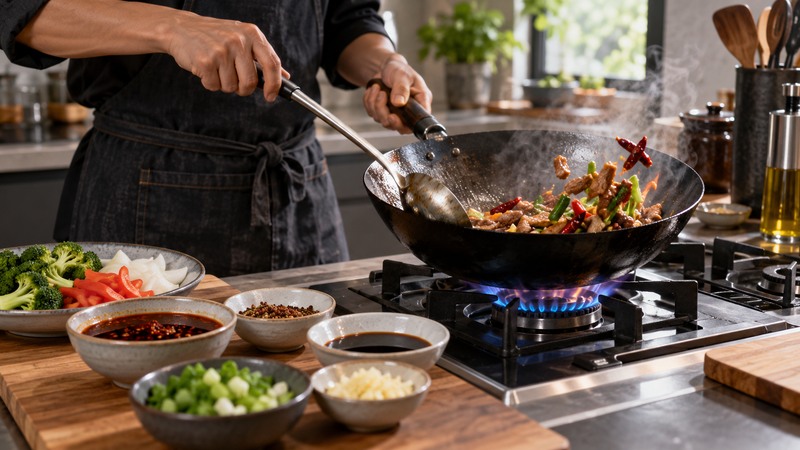
When dinner includes rice, a cold side, and one hot dish, the following order keeps the final minutes manageable:
- Start rice or another staple first.
- Mix the cucumber dressing and prepare the cold side.
- Cut all hot-dish ingredients on separate, clean surfaces as needed.
- Mix the sauce and slurry in labeled or clearly separated bowls.
- Heat the wok only after everything is ready.
- Cook the hot dish and serve it promptly.
Avoid placing cooked food back on a plate that held raw chicken. Wash hands, the cutting board, knife, and nearby surfaces after raw poultry preparation. The goal is not merely speed; it is to move through the fast cooking stage without skipping separation or temperature checks.
A two-dish weeknight plan
For two or three diners, pair smashed cucumber with either mapo tofu or kung pao chicken and serve rice. The cucumber can be dressed while the rice cooks. Mapo tofu is more forgiving if the meal must wait a few minutes; a stir-fry is best served as soon as the sauce coats the ingredients.
| Minute | Cucumber plus mapo tofu | Cucumber plus kung pao chicken |
|---|---|---|
| 0–10 | Start rice; cut and salt cucumber | Start rice; cut and marinate chicken |
| 10–20 | Mix dressing; cut tofu and aromatics | Smash, cut and salt cucumber; mix sauces; prep aromatics |
| 20–30 | Cook meat and sauce; simmer tofu | Drain and dress cucumber; cook chicken in sequence |
| Finish | Thicken gradually; taste; serve | Verify 165°F / 74°C; add peanuts; serve |
These are workflow examples, not fixed doneness timers. Use visual and texture cues for vegetables and sauce, and use a thermometer for poultry.
Store and reheat leftovers safely
USDA FSIS advises refrigerating perishable leftovers within two hours of cooking, or within one hour when the ambient temperature is above 90°F / 32°C. Store food in shallow covered containers so it cools promptly. Refrigerated leftovers are generally kept for three to four days, and reheated leftovers should reach 165°F / 74°C.
Cold cucumber salad loses crispness as it sits, so make only what you expect to eat soon. Noodle sauce may thicken in the refrigerator; loosen it gradually rather than flooding the bowl. Reheat tofu and chicken gently but thoroughly, and discard food that has remained at room temperature beyond the recommended limit. See the USDA pages on chicken safety and leftovers for the underlying guidance.
Frequently asked questions
What is the fastest Sichuan dish for a weeknight?
Smashed cucumber salad is usually the fastest because it needs no stove. For a hot main, noodles can be quick when the sauce and toppings are ready, while mapo tofu uses a short simmer and kung pao chicken uses a short but tightly sequenced stir-fry.
Can I make quick Sichuan recipes less spicy?
Yes. Reduce dried chilies and chili oil, keep extra chili oil at the table, and do not compensate by removing all vinegar, soy sauce, aromatics, or fermented ingredients. The dish will be milder while retaining more of its flavor structure.
What can replace doubanjiang?
No single common condiment matches its fermented chile-bean flavor. Miso plus a small amount of chili paste can provide salt, fermentation, and heat, but the result will taste different. For a dish centered on doubanjiang, buying the ingredient gives a clearer result.
How do I keep a quick stir-fry from becoming watery?
Dry the ingredients, avoid crowding the pan, preheat the wok, and mix the sauce before cooking. Add the finishing sauce only after the main ingredients have cooked sufficiently, and use slurry gradually.
How can I plan two Sichuan dishes at once?
Choose one cold dish and one hot dish. Prepare the cold dish and all sauces first, then cook the hot dish last. This avoids competing for the wok and lets the final dish reach the table with better texture.