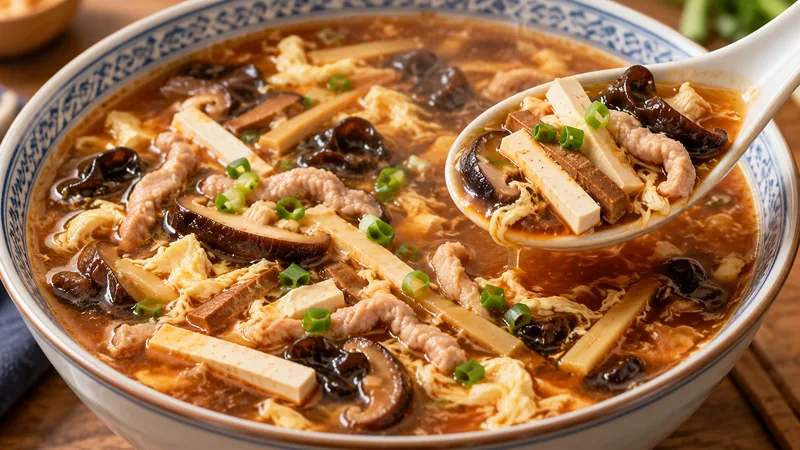
This hot-and-sour soup version uses pork strips, tofu, mushrooms, bamboo shoots and egg ribbons in a lightly thickened broth. Its heat comes mainly from white pepper and its sourness from white vinegar. It follows a published Chinese restaurant-family formula rather than claiming one exclusive traditional Sichuan recipe or transplanting a noodle method into soup headings.
Quick Answer
Prepare the pork and hydrated additions first, simmer them in the seasoned stock, then add tofu and vinegar. Restir the starch slurry and add it gradually before the beaten egg. Keep the soup simmering for the egg ribbons and cook the whole soup thoroughly. Taste heat, salt and sourness after the actual additions are in the pot.
Basic Facts
| Batch | 8 cups low-sodium chicken stock; about 6 servings |
|---|---|
| Pork | 4 oz finely cut pork shoulder with its separate marinade |
| Tofu | 3 oz spiced pressed tofu and 4 oz firm tofu |
| Acid and heat | 1/3–1/2 cup white vinegar; 1–2 teaspoons white pepper |
| Thickening | 1/3 cup cornstarch mixed with 1/4 cup water; add progressively |
| Egg | 1 large beaten egg, streamed after thickening |
Prepare ingredients before heating the soup
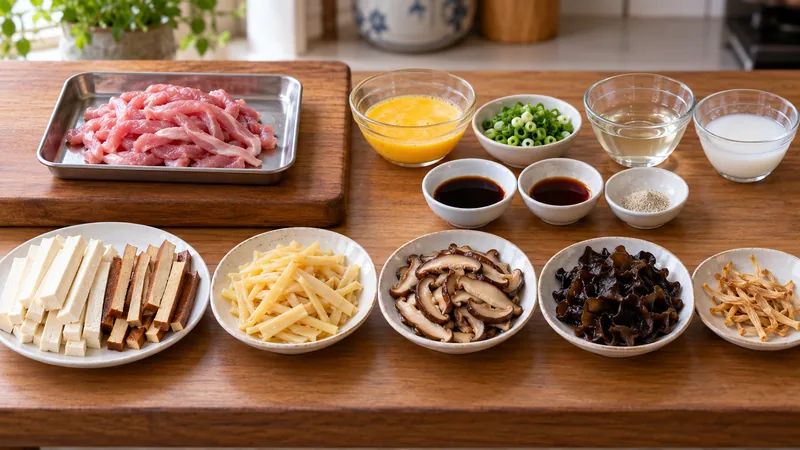
For the pork, use 4 oz finely julienned shoulder, 1 tablespoon water, a pinch of salt, 2 teaspoons vegetable oil and 1 teaspoon cornstarch. For the dried additions, prepare 0.3 oz each dried lily flowers, wood ear mushrooms and shiitake mushrooms, separately hydrated and trimmed. The listed dry amounts are not interchangeable with the larger hydrated volumes.
Use 3 oz spiced pressed tofu, 4 oz firm tofu, 4 oz ready-prepared bamboo shoots, 1 large egg, 1 scallion and 8 cups low-sodium chicken stock. Measure up to 1/2 teaspoon salt, 1/4 teaspoon sugar, 1–2 teaspoons white pepper, 2 teaspoons dark soy, 1 tablespoon light soy, 1 teaspoon sesame oil and 1/3–1/2 cup white vinegar. Optional dried chili is omitted in this version. Keep the 1/3 cup cornstarch and 1/4 cup water for the soup slurry separate from the pork’s teaspoon of starch.
Mix the pork marinade and refrigerate while preparing the other ingredients. Hydrate the dried ingredients according to their packaging and the source method; trim tough flower ends and mushroom stems, slice the mushrooms and chop the wood ear pieces. Use commercially sold edible dried lily flowers, not unidentified garden flowers. Do not treat the photograph of an ingredient as identification of a wild plant or mushroom.
Build the broth and cook the additions
Cut the two tofu types into manageable narrow strips, julienne the ready-prepared bamboo shoots, beat the egg and chop the washed scallion. Keep garnish and its clean utensils separate from raw-pork preparation. Check the pressed-tofu label because seasoning and salt differ by product.
Bring the stock to a boil. Separate any pork clumps and stir the strips into the pot, then return to a simmer. Skim foam if needed. Add the measured salt allowance, sugar, white pepper, both soy sauces and sesame oil. Add the hydrated lily flowers, wood ears, shiitakes and bamboo, and bring the pot back to a simmer.
Add tofu and the initial measured white vinegar portion, stirring gently rather than crushing the strips. This recipe uses white vinegar; black vinegar is a different flavor choice rather than an invisible substitution. Keep enough headroom to stir safely and handle splashing broth cautiously. A heavy-handed boil can break tofu without improving its texture.
Thicken before adding egg
Mix the slurry thoroughly again because starch settles. Add it in a slow stream while stirring the simmering soup, starting with only part of it. Let the pot return to a simmer before deciding whether it needs the remainder. The published formula suggests checking after about three quarters; the full allowance is not an instruction to pour everything into an already thick soup.
Assess the actual spoon-coating texture. If it is too thin, allow the added starch to cook before adding more. If it is too heavy, use a deliberate small addition of hot stock or water and reassess seasoning, rather than treating extra vinegar as a thinning liquid. Each adjustment changes more than one property, so change one thing at a time.
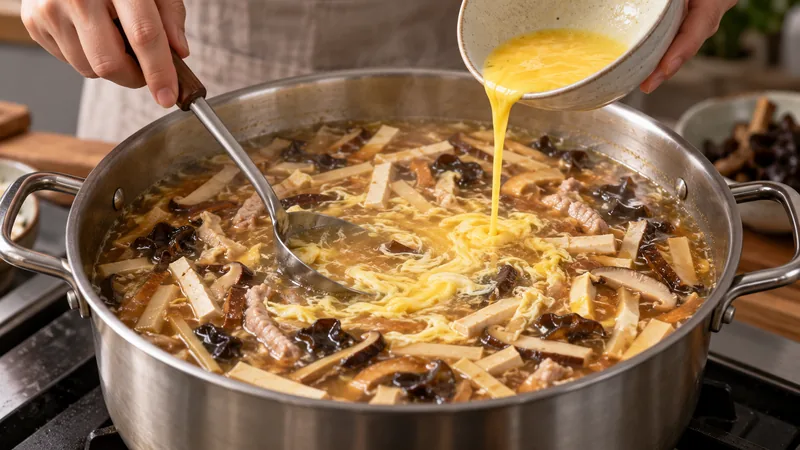
With the soup still simmering, stir to create a controlled circular motion and slowly stream in the beaten egg. Continue cooking so the egg ribbons and the soup are thoroughly cooked; egg-containing dishes should reach 71°C (160°F). Do not use the appearance of pale ribbons or a picture alone as evidence that raw egg or pork is safe.
Balance white pepper, vinegar and serving texture
Taste a cooled spoonful of the fully cooked soup. Use the lower listed vinegar and white-pepper quantities first, then judge whether the upper end suits the batch. A very salty stock or pressed tofu can reduce the need for the optional salt. Adding chili oil changes the oil and chili profile and is not required to make the white-pepper heat meaningful.
Serve with chopped scallion using clean utensils. The bowl should show tofu strips, mushroom pieces and egg ribbons, without being represented as noodle soup or a cucumber dressing. This is a source-based recipe with illustrative images, not a record of the site’s own restaurant history or a kitchen test.
Leftovers and ingredient boundaries
Refrigerate in shallow containers at 4°C (40°F) or below within two hours, or one hour above 32°C (90°F). Do not leave a large deep pot cooling on the counter overnight. Reheat leftovers to 74°C (165°F), stir to distribute heat and check the food rather than only the pan surface.
This measured version contains pork, chicken stock, egg, soy and sesame. A vegetarian or egg-free version needs deliberately adjusted ingredients; removing one food does not justify leaving its cooking instruction or allergen statement unchanged. Source-approved ingredient substitutions should be named plainly, and the changed amounts checked before the pot is assembled.
Quick reference
Prepare all additions, cook pork in seasoned stock, simmer hydrated vegetables, add tofu and white vinegar, thicken gradually, then stream and cook egg. Judge salt, sourness, heat and thickness in the actual cooked soup.
References
- The Woks of Life: family restaurant hot-and-sour soup
- FoodSafety.gov: egg dishes and leftovers
- FoodSafety.gov: separation and chilling
Frequently Asked Questions
Is this the only traditional Sichuan version?
No. This page follows a published Chinese restaurant-family formula and does not establish one exclusive regional recipe.
Does black vinegar give the same flavor?
No. This formula specifies white vinegar; black vinegar makes a different flavor adaptation.
Should the whole slurry go in at once?
No. Restir it, add progressively and simmer before judging the final thickness.
When is egg added?
After thickening, in a slow stream into simmering soup; continue cooking the egg-containing dish thoroughly.
Can I call it vegetarian?
No. This version includes pork and chicken stock as well as egg; a vegetarian version requires a deliberate ingredient change.