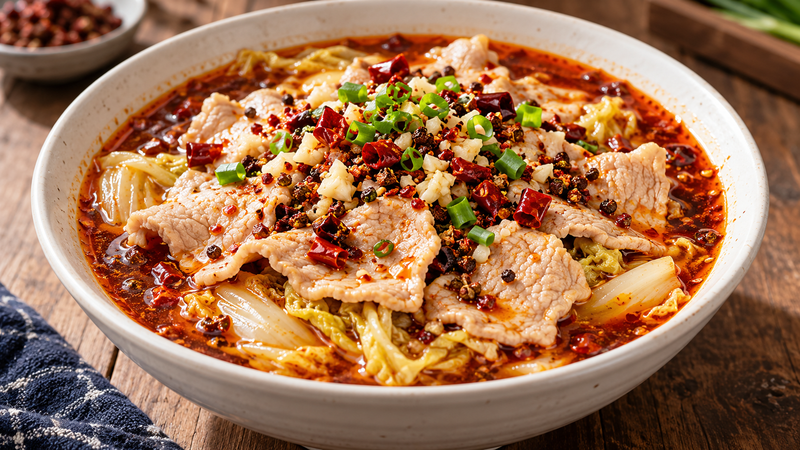
Spicy boiled pork slices, or 水煮肉片 (shuǐ zhǔ ròu piàn), are thin pieces of pork cooked in a seasoned red broth over vegetables. “Water-boiled” describes the cooking method; it does not mean a plain or mild soup. Chili bean paste, Sichuan pepper, and a small aromatic oil finish give this version its character.
This household version makes three servings with rice and uses a relatively small dried-chili topping that you can reduce further. The useful distinction is between cooking the meat and finishing the aromatics: the pork must already be cooked before hot oil reaches the bowl. The finishing oil adds fragrance; it cannot rescue raw centers.
Elaine’s Shui Zhu Pork recipe documents the broader method of starch-coated pork, vegetables beneath the meat, and a hot-oil finish. The smaller spice quantities and cooking checks below are this page’s own household formulation.
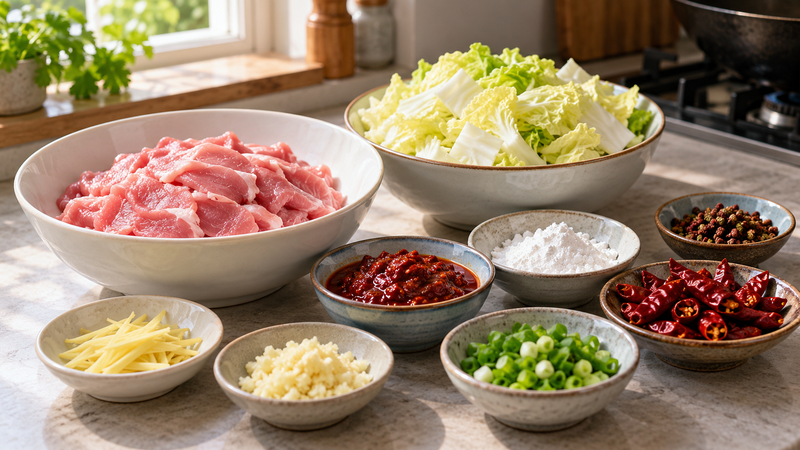
Ingredients for spicy boiled pork slices
Have a large heatproof serving bowl and a thin-tip food thermometer ready. Use pork tenderloin or a trimmed piece of loin, sliced across the grain about 2–3 mm thick. Keep the slices reasonably even so one thick piece does not lag behind the rest.
- 300 g pork tenderloin or trimmed loin, thinly sliced
- 250 g napa cabbage, washed and cut into bite-size pieces
- 750 ml unsalted stock or water
- 1½ tablespoons doubanjiang, finely chopped if coarse
- 2 teaspoons light soy sauce, divided equally between pork and broth
- 1 tablespoon cornstarch
- 2 tablespoons cold water for the pork coating
- 1 teaspoon neutral oil for the pork coating
- 2 tablespoons neutral oil, divided equally between broth and finish
- 10 g fresh ginger, finely chopped
- 4 garlic cloves, minced and divided equally between broth and finish
- 2 scallions, whites sliced and greens finely chopped
- 3 dried red chilies, stems removed, or less to taste
- 1 teaspoon Sichuan peppercorns, or less to taste
- ½ teaspoon sugar
Doubanjiang varies greatly in salt and chili strength. Start with the listed amount and taste the broth before adding the pork; extra salt is not automatically needed. Check paste, soy sauce, and stock labels for allergens. Using water keeps the broth simpler, while unsalted stock gives it more body.
Cook the vegetables, broth, and pork in sequence
- Coat and chill the pork. Mix pork with 1 teaspoon soy sauce and 2 tablespoons cold water until absorbed. Add cornstarch, then the teaspoon of oil. Refrigerate while preparing the other ingredients, about 15 minutes. Use separate utensils for raw and cooked food; do not wash raw pork.
- Prepare the topping. Toast the dried chilies and peppercorns in a dry pan over low heat until fragrant, roughly 30–60 seconds, moving them frequently. Stop before they darken or smoke. Cool, then roughly crush them.
- Cook the cabbage. Simmer it in a separate pan of water until the stems are tender-crisp, roughly 2–4 minutes. Drain thoroughly into the heatproof serving bowl. Thick stems may need longer than thin leaves.
- Build the broth. Warm 1 tablespoon oil over medium-low heat. Stir doubanjiang for about 1 minute without scorching. Add ginger, scallion whites, and half the garlic; stir for 30 seconds. Add 750 ml stock or water, remaining teaspoon soy sauce, and sugar. Simmer for about 5 minutes, then taste.
- Cook the slices in small batches. Bring the broth to a steady simmer. Slide in separate pork slices; let their coating set briefly before gently loosening them. Cook until done, often about 2–3 minutes after a simmer returns, depending on thickness and batch size. This version chooses a 165°F/74°C center endpoint. Check the thickest pieces with a suitable thin-tip thermometer, positioning its sensing area inside the meat rather than reading the surrounding broth. Time and color alone are insufficient. Transfer cooked slices with clean utensils onto the cabbage and pour over the broth.
- Finish the aromatics. Put remaining garlic, crushed chili-pepper mixture, and scallion greens on top. In a small dry pan, heat the remaining tablespoon oil until it shimmers but does not smoke. Remove from heat and carefully drizzle over the topping, keeping face and hands clear of splashes. Serve hot with rice.
Temperature, tenderness, and leftover checks
The official minimum temperature chart lists pork steaks, chops, and roasts at 145°F/63°C followed by a three-minute rest. This recipe deliberately chooses the higher 165°F/74°C endpoint for its small slices; it does not present that choice as the official minimum for every cut of pork.
If slices seem tough, examine thickness, crowding, and time spent in the hot broth after they finish cooking. Cook smaller batches instead of letting a large cold addition stall the simmer. If the coating becomes excessively gluey, check the measured starch rather than adding another spoonful. Burnt garlic or blackened chili cannot be corrected by more sugar; start that component again.
For a gentler bowl, reduce the dried chili and peppercorn topping. Reducing doubanjiang also reduces salt and fermented flavor, so taste the broth again. Chicken is a different protein requiring its own preparation and a 165°F/74°C center; do not assume the same timing. For another pork technique, see fish-fragrant shredded pork, or compare the broth method in Sichuan boiled beef.
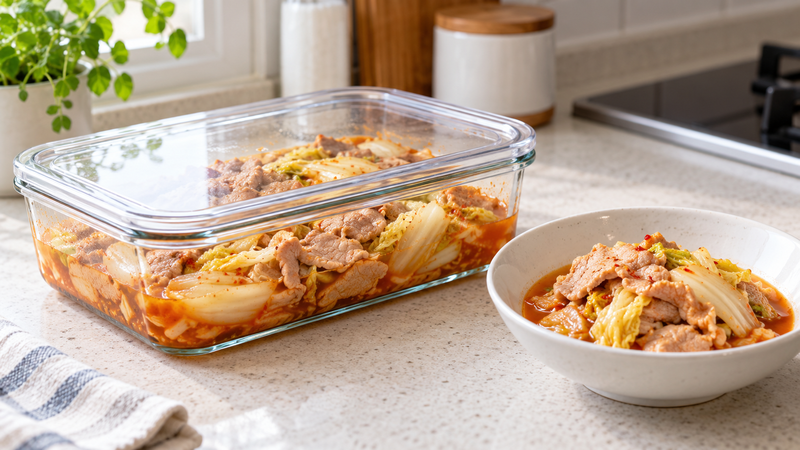
Follow clean, separate, cook, and chill guidance: refrigerate leftovers promptly in shallow containers, within two hours, or one hour above 90°F/32°C. Keep the refrigerator at 40°F/4°C or below. The cold storage chart gives cooked meat leftovers three to four days; reheat to 165°F/74°C. Chili oil does not make the dish shelf-stable.
Questions about shui zhu rou pian
Is this a clear pork soup?
No. This version cooks thin pork slices in a chili bean broth over cabbage and finishes with aromatic oil. The name “water-boiled” does not imply a mild clear soup.
Does the hot oil cook raw pork in the bowl?
No. Cook and check the pork in the simmering broth first. The oil finish is for the topping and aroma, not a reliable way to cook raw centers.
Can I leave out the finishing oil?
Yes, but the topping will have a different aroma and raw garlic can taste sharper. You can instead cook all the garlic in the broth and omit the oil drizzle.
Is floating or turning white enough to judge doneness?
No. Thickness, batch size, and broth temperature vary. Use a suitable thermometer to check the meat’s center rather than treating appearance or a fixed number of seconds as proof.